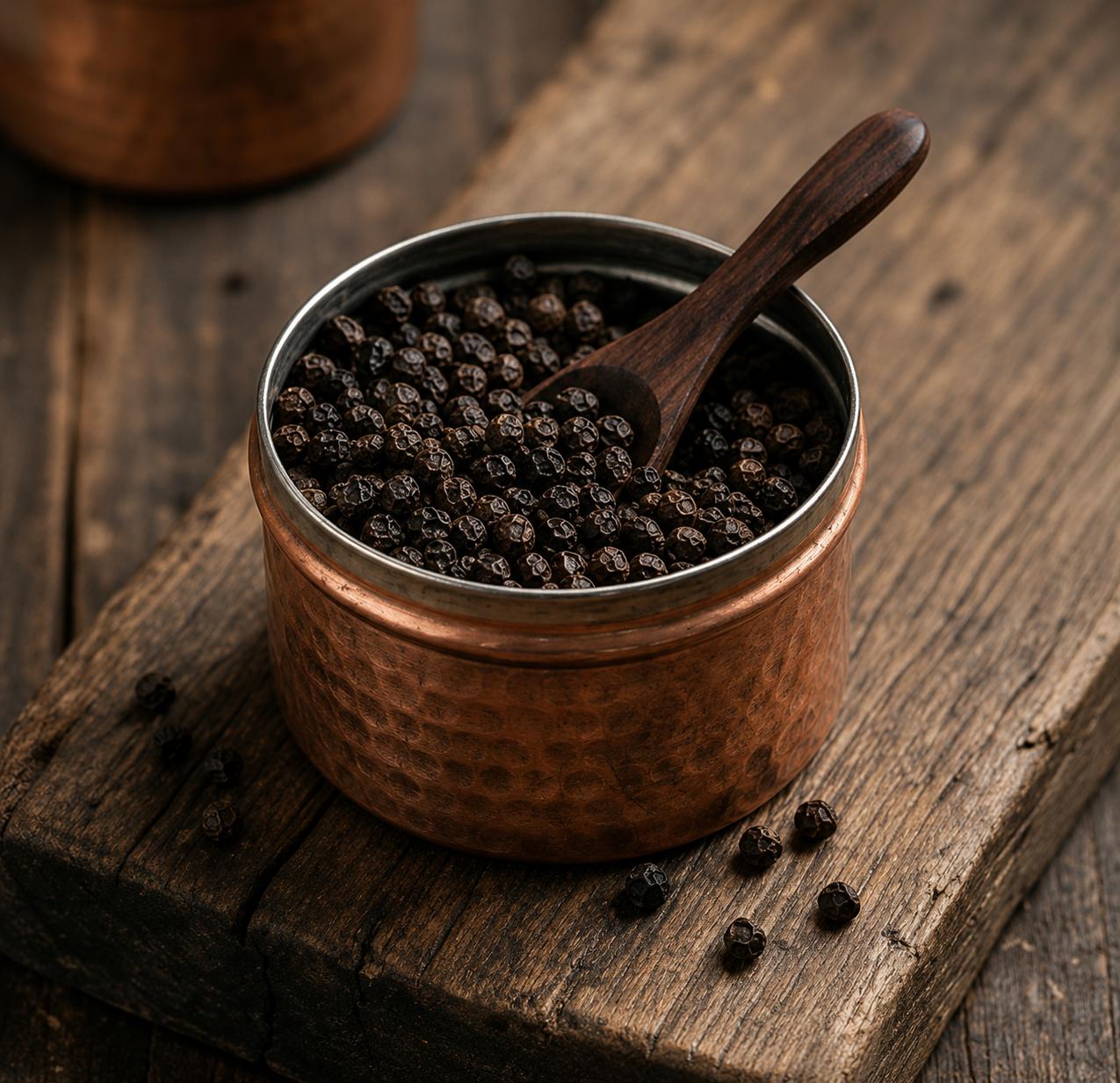
Tellicherry, and the peppercorn that funded fleets
Black pepper is, in the strict botanical sense, a small drupe — a fruit. It grows on a perennial vine that climbs whatever it can find, prefers monsoon rain and altitude, and yields a peppercorn whose pungency comes from a single compound: piperine. Almost every condition the plant prefers happens to converge on the western slopes of the Sahyadri, the mountain range we call the Western Ghats. This is not coincidence. The plant is from there.
For two thousand years, that geography was the point. Roman pepper bills survive from the first century AD; the demand was so steady, and the supply so concentrated on the Malabar coast, that pepper became the medium in which long-distance trade was denominated. Lots from the Kerala highlands moved through the port of Muziris and onward to the Levant, the Hejaz, and eventually Lisbon and Amsterdam. The peppercorn is, in some real sense, the molecule that built early-modern Europe.
But not all peppercorns travelled equally. The trade understood, well before the language of "specifications" existed, that pepper from certain hill-ranges was simply heavier, oilier, and more pungent than pepper from others. The British East India Company, headquartered for a stretch at Tellicherry on the north Malabar coast, codified what the older traders had already known: that the largest, fullest, blackest berries — sun-dried whole, hand-stemmed, garbled to remove broken or shrivelled fruit — could be sold at a clear premium. They invented a grade and named it after the town: Tellicherry Garbled Special Extra Bold. TGSEB.
The grade is still in use. To qualify, a peppercorn must be at least 4.75 mm in diameter, with a bulk density above roughly 560 g per litre and a volatile-oil content of at least 3.5%. Most commodity pepper, even from the same fields, falls short of these numbers. The TGSEB grade is, in effect, the top one or two percent of any harvest. It is what arrives in the small jars of the better European spice merchants. It is also, increasingly, what the better Indian kitchens have begun to ask for again.
What I find moving about the grade is how unromantic it is. There is no story. There is no certification body. There is just a sieve, a hand-held grading tray, and a generation of Malabar workers who learned to tell, by sight and weight in the palm, which berries belong on which pile. The grade is a residue of expertise — a specification that survives only because the people doing the work continue to honour it.
A vine is planted today in Wayanad, and the first commercially useful crop comes off it in year four or five. The vine will then yield for thirty or forty years, and during that span the world will change around it many times. The grading sieve, however, will not. The peppercorn that meets TGSEB in 2046 will be, by every meaningful measure, the same as the peppercorn that met it in 1846. A fact like that, in this century, deserves a quiet respect.